NEW ENGLAND ALMANAC
Portraits in Sound of New England Life and Landscape
by Tom Looker
A series of 13 half-hour radio programs evoking the sounds and stories of rural New England.
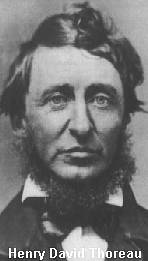
"I believe in the forest and in the meadow and in the night in which the corn grows."
-- Henry Thoreau, Walden
Winner of the Peabody Award (1983)
The Armstrong Award (Columbia University) for Creative Use of the Medium (1983)
The Ohio State Award (1985)
NPR's submission to the 1984 Prix Berlin International Radio Competition
 Listen
to the opening six minutes of the first program, The People of the Lake
(Real Media)
Listen
to the opening six minutes of the first program, The People of the Lake
(Real Media)
(Real Media file, 2.9 Mb)
Listen
to the opening 12 minutes of the fourth program, Snow Drifts (Real Media)
(Real Media file 6.3 Mb)
|
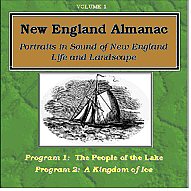
Program 1: The People of the LakeA visit to Lake Champlain in late fall and early winter.
Program 2: A Kingdom of Ice Ice fishing in Vermont and ice stories from Maine and Massachusetts.
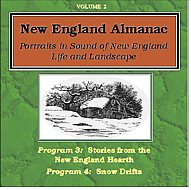
Program 3: Stories from the New England Hearth Sounds of heating with wood and tales of winter told around fires.
Program 4: Snow Drifts Traveling through the winter landscape: sounds and stories of skis, snowshoes and snowmobiles.
Program 5: Heartbeats in the Frozen Land First stirrings of spring: from maple sugaring to the birth of a calf.
Program 6: The Thaw A noisy spring chorus, from peepers to geese; a dairy farm in Cummington, Massachusetts, comes to life. Morris Dancers celebrate in Vermont.
Program 7: Living History Private history within families is compared with public history in museums. Visits to Old Sturbridge and Plimoth Plantation.
Program 8: In Search of the White Village The myth of New England is explored: early industry recreated at Old Sturbridge, the remains of industry left behind in Cummington.
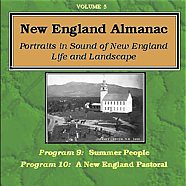
Program 9: Summer People Tourism in New England is as traditional as the White Village. Visits to a music camp, an artists' colony, a summer home in Jaffrey, New Hampshire.
Program 10: A New England Pastoral Young people resettle the countryside: the changing rural community in southern Vermont; sheep farming in Kezar Falls, Maine.
Program 11: The Harvest Portrait in sound of the New England fall, a cycle of death and life: includes logging with a horse in Maine and the slaughter of a steer in Amherst.
Program 12: On the Edge of the Sea South Thomaston, Maine: residents describe the pleasures of village life, while telling stories of its darker side, as well. A trip on a lobster boat.
Program 13: The Woodsman -- or, Natty Bumppo is Alive and Well and Living on an IBM Pension In the forests of northern Vermont, the myths and realities of contemporary New England life collide and co-exist; portrait of a unique mountain man. |
Produced at WFCR, Amherst, by Tom Looker. Distributed by National Public Radio.
A limited number of CD's of the series are available from Tom Looker.
|
|
Selected Liner Notes
INTRODUCTION: WHERE I TRAVELED AND WHAT I TRAVELED FOR
When I recorded the following interviews, or rather the bulk of them, I was traveling alone in New England, collecting voices and sounds for a series of public radio documentaries about the rural landscape and the people who live within it. I journeyed for eighteen months across Massachusetts, Vermont, New Hampshire, Maine and Connecticut. I talked with a variety of New Englanders and I recorded a wide range of sounds. I was curious about the effects of the land on New Englanders and I was fascinated by the prospects of using radio as my reportorial tool. I recorded stories and reflections from New England residents, but I also taped the aural environments which surrounded them. As a consequence of my recording equipment, I found myself “seeing'” New England freshly, as though for the first time. The flight of wild geese, the turning of a wooden water wheel, the crunch of boots in snow, the squeaking of summer katydids: my tape recorder transformed sounds like these into intense aural fragments which acted upon my imagination and my understanding in the same way that colors, shapes, or words stimulate the creativity and insight of painters, sculptors, or writers.
During my travels, I collected one hundred hours of interviews and fifty hours of sounds. Then I retired to an apartment (which my landlord had built) in a large house, across from a swampy field, near the Connecticut River, in western Massachusetts. I worked in my kitchen, cutting tape and writing the scripts which became the thirteen half-hour programs of New England Almanac. The scripts grew into programs late in the night at the studios of our local public radio station, WFCR, Amherst, where I mixed the series with my own hands, learning as I went along. I spent one year and one month in production.
Because I lived alone and worked intensely and at odd hours, friends and relatives didn't see me for long periods of time and they wondered what I was up to: they would ask if I got enough to eat, if I did not feel lonesome, if I was not afraid about how the series would turn out.
To speak sincerely, I must say that I did live with considerable anxiety and uncertainty about what I was doing. In retrospect, it is easy to portray someone who is following his own drummer as a confident visionary, steadfastly pursuing his goal with single-mindedness. In fact, I was often plagued with doubts. Our culture is so preternaturally visual that I often wondered what I was doing working in a medium that so many of my countrymen considered handicapped — nothing more than television without pictures. I did my best work when I was focusing only on the immediate task at hand, not worrying about anything more than the next two or three minutes of program. So, step by step, I completed the journey.
New England Almanac: Portraits in Sound of New England Life and Landscape first aired on public radio in New England during the Fall of 1983. The following summer it was distributed to stations across the country by National Public Radio. Written responses from listeners started to arrive immediately. I was delighted to discover that the series appealed to a wide and diverse audience – from farmers to city dwellers, from children to university professors. I had pursued the Almanac in part to demonstrate the great untapped potential for creative, radio programs, and I took the audience’s enthusiasm as proof of the latent power of “the literate electronic medium.”
REFLECTIONS ON THE ART OF RADIO
When I conceived of New England Almanac, I’d been working in public radio for half a dozen years as a reporter, producer, and script writer. I’d developed a quirky perspective on the medium of radio: I regarded it as a vastly under-used art form. In America, much of radio has been reduced to the status of a jukebox, an oral teletype machine, or a community telephone booth. The characteristic which all these uses of radio share is that the audience is not expected to listen too closely or think too deeply.* Radio provides background squawk to accompany other activities — driving, cooking, or even (irony of ironies) reading.I view radio as capable of a great deal more than filling the silent spaces of our lives. I like to call radio the literate electronic medium. Creative radio programs -- programs which are designed to be listened to – make demands upon the audience that are analogous to the demands a book places upon readers. Radio listeners must be open to language, to cadences of speech, to tones of expression. They must actively use their imaginations (to make pictures) and their memories (to create continuity). Creative radio hearkens back to one of the oldest forms of human expression and communication: oral tradition. Before there was writing, there was oral poetry. If Homer were alive today (and if he turned out to be one person), I don't think he would turn up on the Letterman show, sandwiched between commercials; I believe we'd find him reciting his verse on the radio.
Radio is the “low-tech” electronic medium, using equipment which is far simpler and less costly than television. Some radio producers seem to deny or apologize for this inherent simplicity by indulging in what I would call technological overkill; for them, creativity is equated with multi-track mixes, complex special effects -- the bells and whistles of electronic wizardry . I believe that the lack of technical complexity in radio can be a virtue, particularly for reporters. Television journalists must always be encumbered by the equipment they use. The cameras, lights, microphones, and crew intervene between TV reporters and the people they talk with. By contrast, radio recordings can be made with discrete and relatively unobtrusive gear, by one person, working alone. And the material that radio reporters gather differs fundamentally from what film or video captures. Reporters using audio tape recorders listen closely to language and nuance; they are less easily distracted by outward appearance. Characteristically, radio reporters stand or sit in an informal posture close to their interviewees, and draw them into intimate conversation. People being interviewed for radio documentaries will often open up in surprising ways, speaking eloquently about their inner feelings, hopes, and fears. It is not impossible for sensitive television documentarians to record such inner speech (in Benjamin DeMott's phrase), but it is much more difficult, because TV focuses first on the external pictures of a person's life; these visual surfaces must be transcended if a documentarian is to get at deeper resonances of character and meaning. Radio – the medium of sound and speech, the medium, above all, of the private imagination – naturally focuses attention of reporters (and listeners) on the interior life ... Creative radio programs connect with deep imaginative responses of listeners, that level of the unconscious in which private pictures are formed; the producer gauges what mosaic of aural suggestions will create strong images but the process is one of subtle evocation, an aural conjuring act – less precise even than the written word. Television thrives on literalness; creative radio’s power comes from its mysterious ambiguity.
Adapted from NEW ENGLAND ALMANAC: Voices from
a Changing Landscape
(unpublished manuscript)
The programs in the Almanac series fall into several interrelated sequences. The first six shows follow a cycle of New England seasons, from late fall into spring. Listeners are introduced to the unique sound and style of New England Almanac. Readings from Henry Thoreau help shape each installment and suggest some of the poetic resonances that the series as a whole tries to evoke in its aural design.
In the seventh program, Living History, the series takes a break from the seasonal framework and assumes a slightly more traditional radio documentary form in which “talking heads” discuss a set of ideas – in this case, the relationship of “public” history to “personal” history and the ways in which these different views of the past interact in the New England landscape. Of course, I wanted to illustrate how a talking-heads format might be transfigured by creative radio production, so I envelop the professional historians with a variety of sounds, along with a number “non-professional” voices. The sounds of clocks, the sounds of a farm, the sounds of a mill site interweave with the spoken word to add different layers of interest and meaning to the commentary. Also, I appropriated self-consciously some familiar radio gimmicks in a way that I hope transcended the conventions and conveyed more meaning. (I‘ve long been obsessed with the question, “When is a cliche not a cliche?”) In the opening montage, the clocks “keeping their own time” suggest the multiplicity of perspectives that people bring to history. The creaking of the Streeter’s parlor door puts a sound into the listener’s ear that may seem hackneyed at first. (How many creaking doors have we heard in radio dramas!) But as more doors creak during the program – sometimes barely noticed – I hope that the noise subtly metamorphoses into a theme, or leit-motif, which then becomes dramatically transfigured in the finale, when the swinging gate at Plimoth Plantation becomes an evocation of the links that New Englanders feel between the present and the past.
Program 8, In Search of the White Village, continues to apply techniques of “sound portraiture” to an historical discussion. Programs 9 through 10 return to the some of the style of the first six programs. But Summer People and A New England Pastoral also engage with broad cultural or historical themes; for example, in Program 10, Thoreau joins Leo Marx in an aural picture of a pastoral landscape.
Program 11, The Harvest, is the most unusual and dramatic. It begins with an evocation of fall in New England but the portrait of Peter Haggarty and his draft horse Jake suggests neither Henry Thoreau nor Currier and Ives. Pete logs with a horse but cuts trees with a chain saw. Throughout the program, I try to evoke the ambivalence and ambiguity that lie at the heart of our existence. (“The magic of the fall is multi-colored.”) The major sequence of the program, the slaughter of the steers, conveys vividly my own conflicting feelings about harvests and thanksgivings.
NPR chose to submit The Harvest to the prestigious international radio competition, the 1985 Prix Berlin, but didn’t reckon on the feelings of some non-Western cultures. These jurors found the butchering scene intolerable ... and unlistenable.
In programs 12 and 13, the Almanac changes shape once again, presenting portraits in sound of individual New Englanders. A kind of coda following the emotional wallop of The Harvest, On the Edge of the Sea echoes a number of themes (and ambiguities) brought up in earlier programs, as does, more overtly, The Woodsman. In the story of Earl Playful, New England Almanac comes full circle and much that has been suggested before now gets spelled out and discussed – in the voices of Earl and Elsie, in the words of Thoreau, and in my own commentary.
I’ve often said that I took a “Thoreauvian” approach when I was producing New England Almanac: simplify! simplify! was my mantra. In part I made a virtue out of necessity, since I did not have a large enough budget to hire assistants. But I was also attempting to demonstrate the creative potential for a “low tech” style of radio production – much in the same way as Thoreau wanted to demonstrate the promise of a Spartan, ascetic way of life.
I: Field Equipment
I traveled around New England with simple but high-quality recording equipment. For the essential sounds of the landscape, I borrowed a Nagra portable reel-to-reel tape recorder from WFCR. For many years, this classic machine set the standard for sound recordings in the field. Twenty years ago, the Nagra seemed a marvel of portability, weighing “only” 20 pounds and having the shape of an oversized dictionary. Only with the advent of DAT machines – at less than half the size and weight – has the Nagra’s pre-eminent position at last been challenged.
For my stereo recordings, I used two Sennheiser 421 dynamic microphones. Wonderfully detailed mikes, with superb bass, the Sennheisers have been favored by radio documentarians for many years because they don’t need phantom power, that is to say batteries. (Most high quality professional microphones run off electricity of one sort or another.) But the 421’s achieve their fine sound without power only because they have huge diaphragms. This causes a couple of problems. The mikes are extremely large – almost 9 inches long and 1-1/2 inches square at their fattest point. They are also incredibly sensitive to handling noise, which is to say that they’re almost impossible to hold onto directly. You must use shock mounts that suspend the mikes within elastic supports. The mounts I used were designed for the equally large Neumann U-87 studio mikes and were part of WFCR’s equipment collection. Since I was recording in stereo, I used two Sennheiser 421’s, suspended in two U-87 shock-mounts and positioned at about 90 degrees to each other. This famous “X-Y” pattern produces a fine, all-purpose stereo image. I placed the Sennheiser array on a large pistol grip and moved about the landscape with a Nagra over one shoulder and the microphones held in one or two hands. (The apparatus weighed about 6 or 7 pounds.)
As I always had huge gray foam windscreens over each mike, the funny-looking contraption raised many eyebrows. On the slopes of Mount Snow, a skier asked me if I was using a radar gun to check for “speeders.” Almond Streeter had his own pet-name for the equipment: he called it “Snoopy.”
The Nagra was too bulky – and would have consumed too much expensive reel-to-reel tape – for me to use it for interviews. Instead, I used a Sony TCD-5 M stereo cassette deck for the bulk of my voice recordings. This small machine (weighing around a pound) produces astonishingly fine sound. My main voice microphone was a Shure SM-85 – an exceptionally light, well shock-mounted condenser mike with studio-quality sound, A small battery pack (made by Charlie Ferguson at WFCR) powered the Shure. Often I found myself recording interviews in stereo – as, for example, when I talked with Earl and Elsie Playful about their winter memories. Here I plugged “Snoopy” into the Sony, with excellent results.
II. Production Equipment
New England Almanac presents a distinctive mix of voices and sounds in high quality stereo sound. As unusual as the production values may be, the methods I used to create the series are even more idiosyncratic. Though the basic tools I used for recording (like the Nagra tape recorder and the Sennheiser microphones) were of extremely high quality, I did not have access to any sophisticated production equipment once I started to assemble the programs. I owned a Revox B-77 half-track tape recorder on which I did all my editing. I mixed the programs in the WFCR studios and several of the tape machines there were high quality – especially the MCI console on which I did all my recording. But in 1983, multi-track recording machines were still a rarity in public radio. You mixed together program elements by setting up two or three or four tape machines to feed the one upon which you were recording. Getting the timings and balances right (pushing the right “start” buttons and fiddling with the various volume knobs correctly) often became an athletic, as well as an aesthetic, performance.
A further wrinkle at WFCR concerned the placement of stereo images. The main mixing console did not include a “panning” feature, allowing you to put a particular voice in a particular place (further to the left, further to the right, etc.) I figured out a complicated way to adjust a monaural feed from a couple of Revox machines to achieve such placement. But it wasn’t an easy matter.
Finally, WFCR had no noise-reduction technology (such as Dolby A). Since I worried about the amount of hiss that would be added as I mixed and remixed the programs, I made the unusual decision to do all my production work at twice the normal reel-to-reel tape speed, 15 inches per second instead of 7-1/2. I got so used to the higher quality sound that I eventually recorded the master tapes and distribution copies of each program at 15 ips. Though European radio documentarians always use this high speed, as a rule, Americans never do. The fine sound of the Almanac depends in no small measure on my use of 15 ips in production.
I am sometimes asked how I learned to produce radio. I have a hard time answering the question. I never had any formal training. When I was a free-lance reporter and writer in the late 1970’s and early 1980’s, I watched and listened to many fine producers and engineers at NPR in Washington and at WGBH in Boston. I edited a lot of tape when I reported for programs like Options in Education, All Things Considered, and the arts magazine, Voices in the Wind. I spent a few months in Washington as assistant producer for Options in Education. But my apprenticeship in radio production was largely unconscious; my understanding and my sensibility “grew like corn in the night” and flowering fully only when I started putting together the Almanac series itself. ...
I did all my pre-production work in my home in Montague Center. I set up my Revox tape recorder in a corner of my large kitchen and dubbed cassettes and edited all my tape on this machine. I recorded my narrations in my bedroom closet, usually in the evening, but as I lived on a quiet street, the only extraneous noise I really had to worry about was that my landlords might use their bathroom in the middle of a taping session.
|
Peabody Award, April 1983 Listeners fortunate enough to tune into the series of sound portraits which Thomas Looker has wrought out of the rich heritage of New England can enjoy what radio does best – painting pictures in the mind. One travels through the woods to grandmother’s house, drops a hook through the ice of Lake Champlain, takes part in the mysterious transformation of the sap of the sugar maple into the wonders of maple syrup, and enjoys the rustle of the fall leaves, all without moving from the easy chair. It is a wonderful journey which every American should take and which every American would enjoy. In the opinion of the Peabody Board this fine effort is worthy of Peabody recognition. |
Response to the award presentation by Tom Looker
This is a tremendous and wholly unexpected honor – particularly for one who edited tape in his kitchen and went into a closet to record narrations.
I would like to accept this award not only for myself but on behalf of all those independent producers in public radio who believe that radio is not simply television without pictures, but in fact a vastly underused art form, whose creative power and flexibility have barely been tapped in this country. I’d also like to accept on behalf of those small public radio stations like WFCR, Amherst, Massachusetts, where I produced the series, who believe that at a time of budget cutbacks at the national level, it’s the responsibility of local stations to supply innovative, exciting, and artful radio programs. And finally on behalf of the NEW ENGLAND ALMANAC audience, a large and diverse audience, ranging from farmers to academics, whose great enthusiasm for the series contradicts the fashionable notion that no one out there will listen to creative radio programs.
I’d like to thank the Katherine and Gilbert Miller Fund, the staff of WFCR for their support, special thanks to Bob Goldfarb, now of KUSC, Los Angeles, without whose encouragement and vision the project would not have started; and a particular thanks to the wonderful group of New Englanders who appear in the programs, without whose generosity and friendliness, NEW ENGLAND ALMANAC would not have been possible.
|
Ohio State Award, April 1985 That the judges were entranced with this entry is summarized in a one-word statement of one of the judges – Bull’s eye! “New England Almanac” provides a graphic, intimate and informative view of New England. It produced a sense of being there without benefit of sight, relying heavily upon aural senses. The producer has obviously taken a straight-forward approach; used a simple format; planned it well; executed it in a quiet, thoughtful manner; and then paid tremendous attention to the details of editing and “scene” selection. All of this was capped off by excellently edited understandable sound, making the most of radio’s creative potential. This was a superior undertaking and unanimously selected by the judges as an Ohio State Awards recipient. (The Almanac received a highly-unusual perfect score of “10” from each member of the jury.) |
From a review in The Christian Science Monitor, September, 1984
[Looker has done] the unexpected. He has created a picture of New England as vivid and colorful as the most lavish TV documentary could.
Return to Thomas Looker Home Page
Correspondence: nealmanac (at) attbi.com
This page was last modified on June 26, 2003 It has been
accessed
times.